

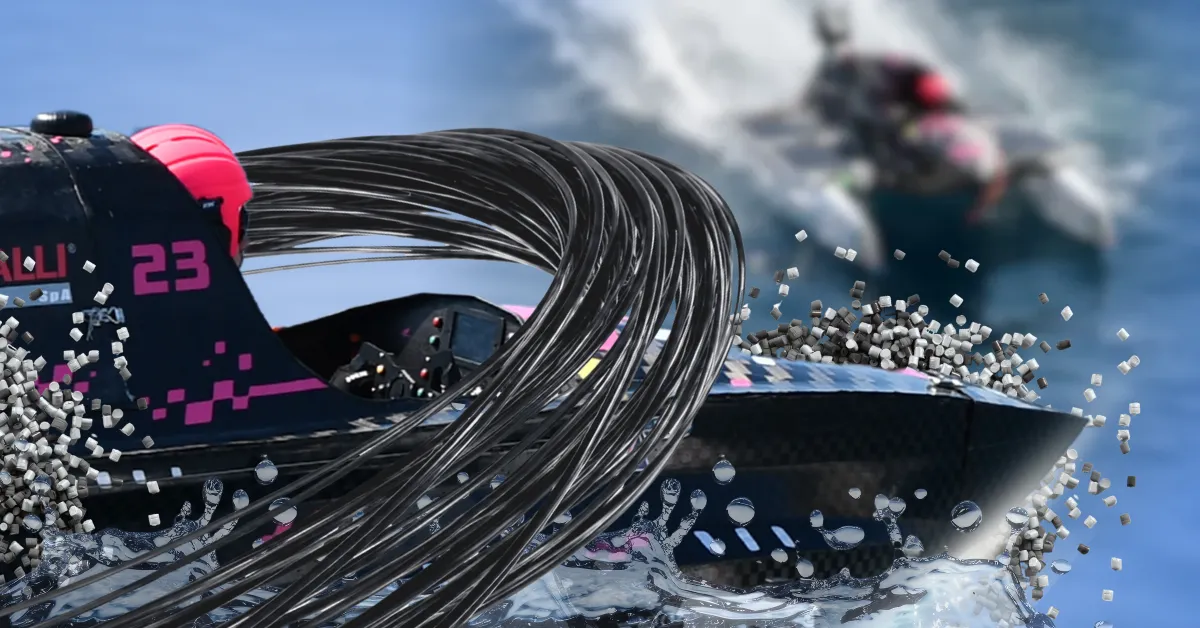
From design to competition: LATI3Dlab technical compounds supported the production of functional components for PB526, the electric catamaran awarded the Innovation Prize and third place in the Energy Class.
From Rollout to the Podium: The Development of the PB526 Electric Catamaran
On 29 June 2026, during the rollout event held at Politecnico di Milano, the Physis PEB – Polimi Energy Boat student team unveiled PB526, its new electric catamaran prototype developed to compete in the Monaco Energy Boat Challenge.
The collaboration between LATI3Dlab and Physis PEB did not begin with this project. Having already supported the team during the previous edition of the competition, LATI3Dlab renewed its technical contribution for the 2026 season by supplying advanced additive manufacturing compounds for the production of functional components.
PB526 represents a further step forward in this ongoing collaboration, combining sustainable mobility, electric propulsion, structural design, and 3D printing within an international competitive environment dedicated to low-emission marine technologies.
For the 2026 project, the team completely redesigned the chassis, producing, for the first time in the history of the Energy Class, a self-supporting monocoque structure almost five metres long.
The propulsion system also underwent major development. The motor tower was redesigned to integrate not only the electric motor, but also the inverter, part of the onboard electronics, and the corresponding cooling system.
At the 2026 Monaco Energy Boat Challenge, which concluded on 11 July at the Yacht Club de Monaco, Physis PEB won the Innovation Prize and secured third place in the Energy Class, competing against 21 teams from more than ten countries.
The Innovation Prize is awarded by the international jury to the project that stands out for the originality of its solutions, their potential impact, and their practical applicability to the future of sustainable navigation.
The team also achieved:
- second place in the Endurance Race;
- second place in the Speed Race;
- second place in the Slalom Race;
- fourth place in the Championship Race, despite a technical issue.
These results enabled Physis PEB to improve its position by three places compared with the 2025 ranking and return to the podium after four years.
LATI3Dlab Compounds for Functional 3D-Printed Components
Continuing a collaboration established during the previous edition of the Monaco Energy Boat Challenge, LATI3Dlab once again supported Physis PEB in the design and production of several functional components for PB526.
For the new catamaran, the team did not rely on a single general-purpose filament. Instead, it selected different reinforced additive manufacturing compounds according to the mechanical, elastic, dimensional, and safety requirements of each application.
The materials used included:
- LASTANE 50 AM M/10 and LASTANE 50 AM K/20, TPU compounds reinforced with glass fibre and carbon fibre, respectively;
- LATIBLEND 7587 AM K/10, a PC/PBT compound reinforced with 10% carbon fibre;
- LATER G AM UVH/V0HF, a V0 flame-retardant, halogen-free PETG compound.
This application-specific material selection demonstrates how 3D printing can be used not only for geometric prototyping, but also to manufacture components designed to perform mechanical, structural, damping, or electronic-protection functions.
The continuity of the collaboration also made it possible to progressively expand the use of LATI3Dlab materials across a broad range of components for the chassis, propulsion system, foils, solar panels, and onboard electronics.
LASTANE 50 AM M/10 and K/20: Reinforced TPU Compounds for Damping and Support Applications
For several support, connection, and damping elements, Physis PEB used two TPU-based compounds:
- LASTANE 50 AM M/10, reinforced with glass fibre;
- LASTANE 50 AM K/20, reinforced with carbon fibre.
The elastomeric matrix provides controlled deformability, resilience, and the ability to absorb impacts and vibrations. The fibrous reinforcement contributes to improved dimensional stability of the printed component and enhances its mechanical response compared with an unfilled TPU.
On the PB526 catamaran, the LASTANE compounds were used to manufacture:
- clamps for the solar-panel support bars;
- damping washers for the bolted connection between the motor mount and the transom;
- damping washers for the connection between the chassis and the transverse tubes via clamps;
- damping positioning supports for the auxiliary battery.
These applications highlight the potential of reinforced engineering TPUs when elasticity, vibration damping, customised geometries, and suitable mechanical performance must be combined.
3D printing also makes it possible to adapt the shape, thickness, and configuration of each component to the characteristics of the connection or supported element, without requiring dedicated moulds.
LATIBLEND 7587 AM K/10: Carbon Fibre-Reinforced PC/PBT for Structural Components
LATIBLEND 7587 AM K/10 is a PC/PBT-based compound reinforced with 10% carbon fibre, developed for additive manufacturing applications requiring stiffness, mechanical strength, and dimensional stability.
On the PB526 catamaran, the material was used to manufacture:
- propellers;
- clamps connecting the chassis to the transverse tubes;
- connection supports between the foils and the longitudinal tubes;
- foil connection elbows;
- foil end tips;
- a spacer between the steering wheel and its mounting interface.
The connection supports between the foils and the longitudinal tubes are part of a longer-term development project and were not installed during the competition.
Among the most significant applications were the 3D-printed propellers, which require stiffness, mechanical strength, geometric accuracy, and dimensional stability under operating conditions associated with the marine environment.
Additive manufacturing enabled the team to modify geometries rapidly, reducing the time required to move from design to component production and testing.
The use of LATIBLEND 7587 AM K/10 therefore demonstrates how a carbon fibre-reinforced compound can extend the role of additive manufacturing beyond aesthetic or dimensional prototyping, supporting the production of functional parts intended for testing and real-world use.
LATER G AM UVH/V0HF: Flame-Retardant PETG for Batteries and Electronics
For components associated with the auxiliary battery and electronic systems, the team used LATER G AM UVH/V0HF, a technical PETG-based compound featuring V0 flame-retardant performance and a halogen-free flame-retardant system.
The material was used to manufacture:
- auxiliary battery supports;
- electronic enclosures;
- electronic circuit-board supports.
In these applications, the geometric freedom offered by 3D printing must be combined with adequate dimensional stability and properties consistent with the presence of electrical and electronic devices.
LATER G AM UVH/V0HF enables the development of customised supports and enclosures adapted to the available installation space and the specific configuration of the onboard system.
The ability to manufacture customised elements in-house also facilitates updates to the electronic layout, modifications to mounting points, and the rapid replacement of components during development and testing.
From Prototyping to Competition: Additive Manufacturing for Real-World Applications
The PB526 project demonstrates the value of additive manufacturing when material selection is based on the actual function of the component.
Within the same catamaran, 3D printing was used to manufacture elements with widely differing requirements:
- elastomeric components with damping functions;
- structural connections and clamps;
- propulsion-system elements;
- foil components;
- battery supports;
- electronic enclosures and supports.
This approach delivered several design and manufacturing benefits:
- rapid geometry modifications;
- production of customised components without dedicated moulds;
- manufacture of small series and replacement parts;
- integration of multiple functions into the printed geometry;
- selection of the compound according to the requirements of each application;
- reduced lead times between design, production, and testing.
“PB526 demonstrates what additive manufacturing can deliver when material selection starts from the function of the component. On the same platform, reinforced TPUs, carbon fibre-reinforced PC/PBT, and flame-retardant PETG addressed very different requirements, ranging from damping and structural support to dimensional stability and the protection of electronic systems. This is the LATI3Dlab approach: engineering the compound around the application, rather than adapting the application to a general-purpose filament.” Francesco Manarini, R&D Manager, LATI & LATI3Dlab
Francesco Manarini, R&D Manager LATI & LATI3Dlab
The project highlights more than the speed offered by 3D printing. Above all, it demonstrates how compounds specifically developed for additive manufacturing can support components intended to operate under real mechanical, environmental, and functional conditions.
The ongoing collaboration with Physis PEB also allows LATI3Dlab to evaluate its materials against practical design requirements, contributing to an iterative process that includes compound selection, production, testing, and component optimisation.
Applied Innovation Recognised at the Monaco Energy Boat Challenge
The Innovation Prize and third place in the Energy Class recognise the multidisciplinary work carried out by Physis PEB.
PB526 combines a self-supporting monocoque structure, an integrated propulsion architecture, solar-energy management, and numerous components manufactured using additive technologies.
The project is a concrete example of collaboration between a university, young engineers, technical partners, and materials specialists, aimed at developing and validating innovative solutions under real operating conditions.
For LATI3Dlab, the renewed collaboration with Physis PEB confirms that technical materials for 3D printing can go beyond the production of visual or dimensional prototypes.
When the compound, printing process, geometry, and function are designed as an integrated system, additive manufacturing can become an effective tool for producing functional components, customised parts, small production series, and high-engineering-content applications.
LATI and LATI3Dlab congratulate the entire Physis PEB team on winning the Innovation Prize and achieving a podium finish at the 2026 Monaco Energy Boat Challenge.
FAQ
Which LATI3Dlab materials were used on the PB526 catamaran?
The team used the reinforced TPU compounds LASTANE 50 AM M/10 and LASTANE 50 AM K/20, the carbon fibre-reinforced PC/PBT compound LATIBLEND 7587 AM K/10, and the flame-retardant PETG compound LATER G AM UVH/V0HF.
Had LATI3Dlab already collaborated with Physis PEB?
Yes. LATI3Dlab had already supported Physis PEB during the previous edition of the Monaco Energy Boat Challenge. The collaboration continued in 2026 with a broader range of materials and functional components.
Why was LATIBLEND 7587 AM K/10 used for the propellers?
The compound combines carbon fibre reinforcement, stiffness, mechanical strength, and dimensional stability. These characteristics make it suitable for the additive manufacturing of functional components with complex geometries.
What is the function of the LASTANE compounds on PB526?
The LASTANE compounds were used for clamps, damping washers, and battery supports. The TPU matrix combines elasticity, vibration absorption, and controlled deformation.
Why use a flame-retardant PETG for electronic components?
A technical flame-retardant PETG combines geometric customisation, dimensional stability, and properties suitable for manufacturing supports and enclosures intended for electrical and electronic systems.

 Accessibility Statement